
UNPACKED #002
Years ago, I heard the CEO of one of Norway’s largest media companies say something I’ve never forgotten.
“I never hire people who stand still on the escalator.”
At first, it sounded like one of those provocative leadership quotes that gets repeated because it’s memorable.
But the longer my career has unfolded, the more I think he was talking about something entirely different.
Not ambition.
Not work ethic.
Not even speed.
He was talking about movement.
The instinct to keep moving forward even when the system is already carrying everyone else.
Twenty-five years later, I think I’ve finally understood why that sentence stayed with me.
Because I’ve spent most of my professional life inside organisations that had brilliant strategies...
...but sometimes struggled to move.

Over the last twenty-five years I’ve built companies from scratch, advised executive teams, and worked inside organisations ranging from global corporations like IKEA and Ericsson to public institutions and entrepreneurial ventures.
The missions have been completely different.
The cultures couldn’t have been more different.
Yet I’ve kept encountering the same question.
Who actually owns movement?
Not strategy.
Not governance.
Not reporting.
Movement.
We’ve become exceptionally good at creating strategies.
Vision statements.
Transformation programmes.
Operating models.
Roadmaps.
Governance frameworks.
KPIs.
Every few months another strategy is launched.
The executive team aligns.
The presentation decks look convincing.
The organisation nods.
And then...
...not very much happens.
Not because people lack talent.
Not because leaders lack ambition.
But because we’ve become remarkably good at designing organisations where almost everyone owns risk...
...while almost nobody owns momentum.
One observation has stayed with me throughout my career.
Whenever I worked close to executive leadership, my mandate was surprisingly clear.
Challenge assumptions.
Question existing ways of working.
Start experiments.
Create momentum.
Movement wasn’t something to ask permission for.
It was the job.
But something interesting happened as that mandate travelled further into the organisation.
The work itself didn’t become less important.
The people didn’t become less capable.
The incentives simply changed.
Instead of creating momentum, leaders became responsible for predictability.
Instead of challenging assumptions, they became responsible for alignment.
Instead of experimentation, they became responsible for avoiding surprises.
Not because they suddenly became more cautious.
Because the system rewarded caution.
That distinction matters.
Because it shifts the conversation away from personalities and towards design.
I’ve come to believe that organisations don’t just cascade strategy.
They cascade permission.
A message that begins at the executive level as
“Use your judgement.”
can become
“Be careful.”
One level later.
And eventually
“Don’t make mistakes.”
No one intends this.
It simply happens.
Each layer translates the original ambition through its own responsibilities, incentives and perceived risks.
With every translation, a little permission disappears.
Until one day, everyone is waiting.
Waiting for approval.
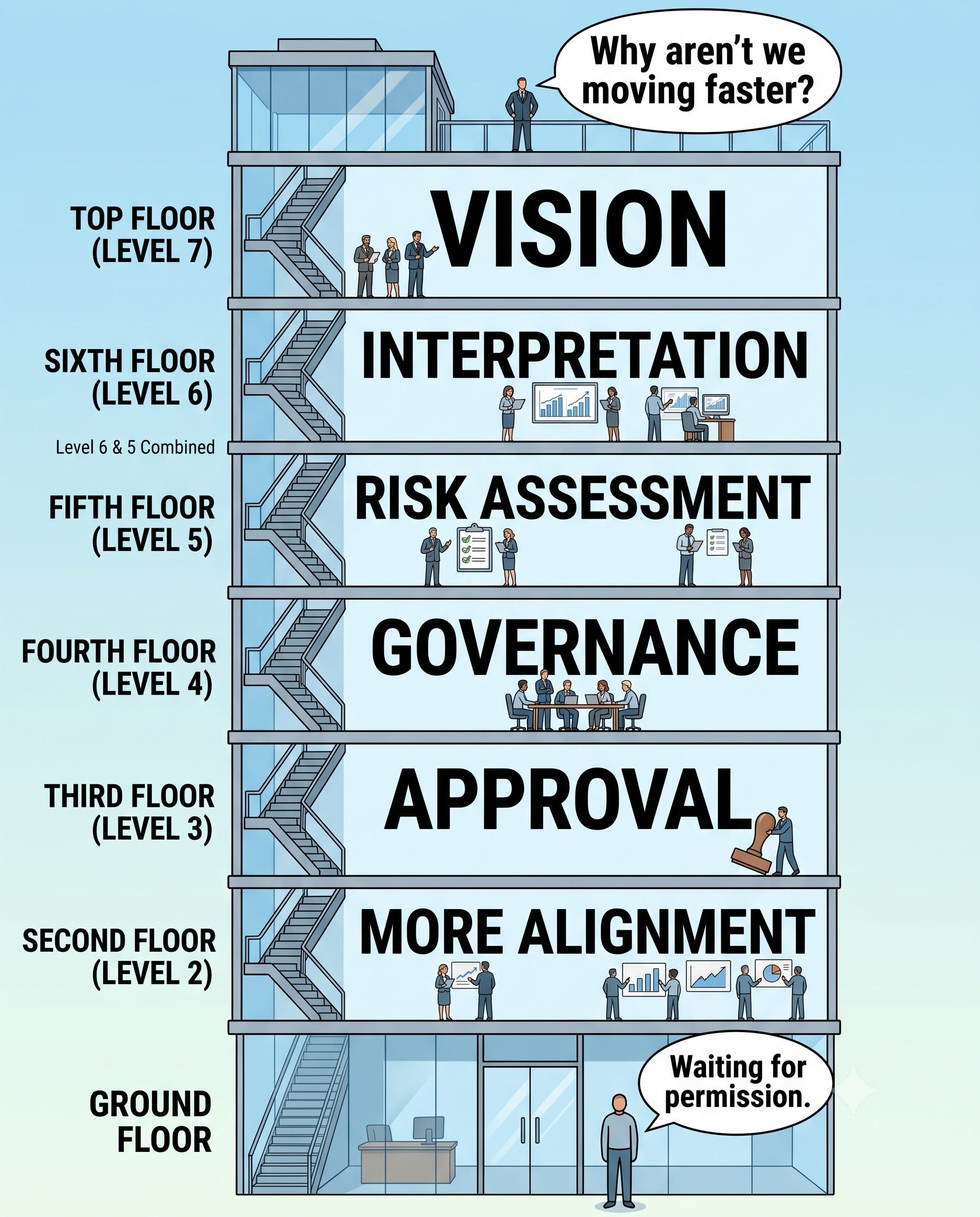
Waiting for another steering committee.
Waiting for the next workshop.
Waiting for somebody else to move first.
The organisation is still moving.
Like an escalator.
Budgets are approved.
Meetings happen.
Reports are delivered.
Projects continue.
From the outside, everything appears to be progressing.
But very few people are actually walking.
This is why I think we’ve overlooked one of the most important leadership roles of the next decade.
We often describe second and third line leaders as translators of strategy.
I think that’s far too narrow.
They are the custodians of organisational momentum.
They occupy the exact point where strategy either becomes behaviour...
...or bureaucracy.
Their responsibility isn’t simply to communicate decisions made elsewhere.
It is to preserve the original permission to move.
To protect curiosity.
To encourage experimentation.
To make sure initiative survives the journey from the executive floor to everyday reality.
Because strategy doesn’t change organisations.
People do.
And people move when they believe they are allowed to.
Perhaps this matters more today than ever before.
Artificial intelligence is reshaping industries.
Geopolitical realities shift by the month.
Technology cycles are measured in weeks instead of years.
Resilience is replacing optimisation as the defining capability of successful organisations.
Yet many organisations continue responding with another strategy.
Another transformation programme.
Another governance model.
Perhaps what we’re missing isn’t another framework.
Perhaps we’re missing leaders whose explicit responsibility is to create movement.
Looking back, I don’t think that Norwegian CEO was hiring people because they walked faster than everyone else.
I think he was looking for people who understood something fundamental.
Escalators don’t create progress.
They simply make movement easier.
Progress still depends on people who choose to walk.
The same is true for organisations.
Strategies create direction.
Systems create structure.
But movement...
Movement is still a choice.
I’ve spent much of my career believing I worked in innovation.
I’m beginning to think I was actually working in movement.
Perhaps that’s the leadership discipline we’ve forgotten.